Counter, Consultation, Confirmation: A Deafblind Access Standard for Leeds Pharmacies
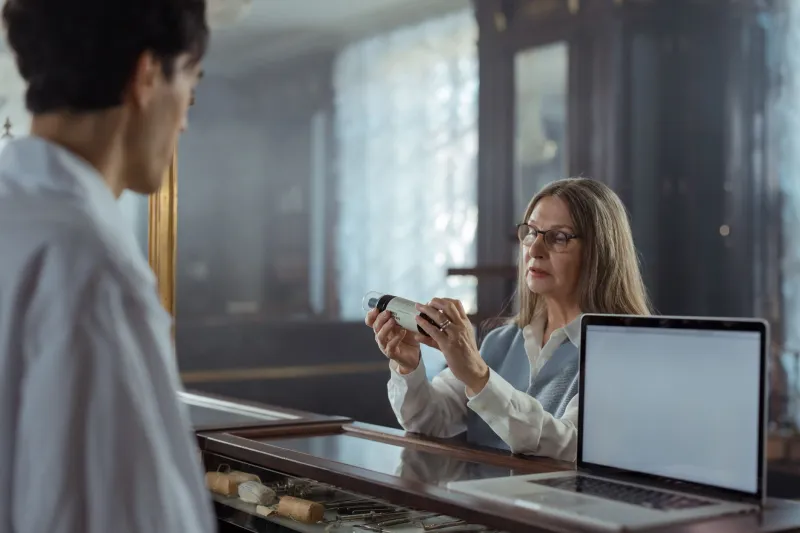
For many people, the pharmacy is the final health setting in a long chain of appointments, prescriptions and instructions. It is also where the consequences of poor communication become immediate. A deafblind person who has navigated a GP surgery, a hospital clinic or a repeat prescription system can still be left uncertain at the counter about dosage, timing or side effects. Access in Leeds pharmacies therefore deserves more attention than it usually receives.
Why the pharmacy counter matters
Community pharmacies are not simply shops. They deliver NHS services, medicines advice, vaccinations, reviews and, increasingly, structured clinical support. For deafblind patients, the counter is the point at which a prescription becomes a practical routine at home. If the interaction is rushed, poorly lit, masked by glass or dominated by background noise, the risk is not merely inconvenience. It can affect whether medication is taken safely and whether a patient feels able to raise a concern.
The Accessible Information Standard requires NHS and adult social care services to identify, record and meet people's communication needs. The Equality Act 2010 also requires reasonable adjustments. In practice, however, deafblind patients in Leeds report that pharmacy access depends heavily on the individual member of staff on duty, the layout of the premises and whether a request for support was made in advance. Good practice exists, but it is not yet consistent.
Barriers that persist at the final few metres
Many pharmacy counters are designed for speed and transaction rather than conversation. Queuing systems may rely on visual displays or verbal calls. Perspex screens can obscure lip patterns and facial expression. Lighting may be bright overhead but poor for reading a label or seeing hands. Background music, till noise and conversations can make speech difficult even for someone with some residual hearing.
For deafblind patients, the barriers often combine. A person may not see a hand gesture towards a card reader, may not hear a name called for a consultation, or may not be able to read a small-print label at the counter. Medication counselling may be offered verbally in an open area, with no quiet space and no easy way to request a different format. Accessible labelling is improving in some systems, but it is not universal, and requests can be lost between hospital, GP and community pharmacy.
What a good pharmacy interaction looks like
A deafblind-friendly pharmacy does not need to be elaborate. It needs to be predictable. The first step is a simple record of the patient's preferred communication method: written notes, email, text message, British Sign Language interpreting, deafblind interpreting, lip-speaking, clear speech or a combination. That record should be visible to staff who need it and should follow the patient across repeat visits.
The second step is a suitable space. A private consultation room is useful only if it is well lit, free from unnecessary noise and large enough for a guide, interpreter or support worker. Staff should know how to offer tactile guiding or simply to identify themselves before speaking. At the counter, staff should face the patient, avoid covering their mouth, speak clearly and be willing to write things down. These are modest adjustments, but they transform the interaction.
The third step is confirmation. It is not enough to hand over a bag and assume understanding. A pharmacy should check that the patient knows how and when to take the medicine, what to do if a dose is missed and where to seek advice. For deafblind patients, that confirmation may need to be in large print, braille, audio or a follow-up message in an agreed format.
A practical checklist for deafblind patients in Leeds
Before visiting, contact the pharmacy and ask what communication support is available. Request a named contact if possible. Ask whether a quiet appointment time can be arranged and whether medication labels can be produced in an accessible format. If an interpreter is needed, ask how much notice the pharmacy requires.
At the visit, identify yourself clearly and state your preferred way of communicating. Ask staff to face you and to write down key points if speech is not reliable. If you use a card or communication passport, show it at the counter. If you are collecting a prescription for someone else, confirm that the pharmacy has the correct consent and contact details.
After the visit, check that you have the information you need in a format you can use. If something is unclear, ask for it to be written or sent by an agreed method. These requests are not special favours. They are part of accessible healthcare.
What pharmacies can do now
A simple deafblind-friendly pharmacy standard could be adopted by independent chemists and national chains alike. It would include a communication preference recorded on the patient record, a named staff lead for accessibility, basic training in deafblind awareness, a quiet area for conversations, accessible labelling options and a clear way to give feedback. It would also include a commitment to review signage, queuing systems and counter layout.
National chains can support local branches by providing templates and training, but they must allow enough local flexibility for staff to respond to individual needs. Independent pharmacies need practical support rather than another unfunded mandate. In Leeds, pharmacy teams, deafblind residents and local advocacy organisations could co-design a short standard that is realistic, auditable and visible to patients.
The case for a Leeds standard
The final few metres of a pharmacy visit should not undo the work of an entire health journey. A deafblind person should be able to collect a prescription, understand the instructions and raise a concern without having to rely on luck or on the goodwill of one particular member of staff. Leeds has a strong network of community pharmacies and a clear opportunity to make accessibility a normal part of the counter, the consultation and the confirmation. That is the standard patients should be able to expect in 2026 and beyond.