Signals, Surfaces and Safe Passage: A Deafblind Audit Guide to Leeds City Centre Crossings
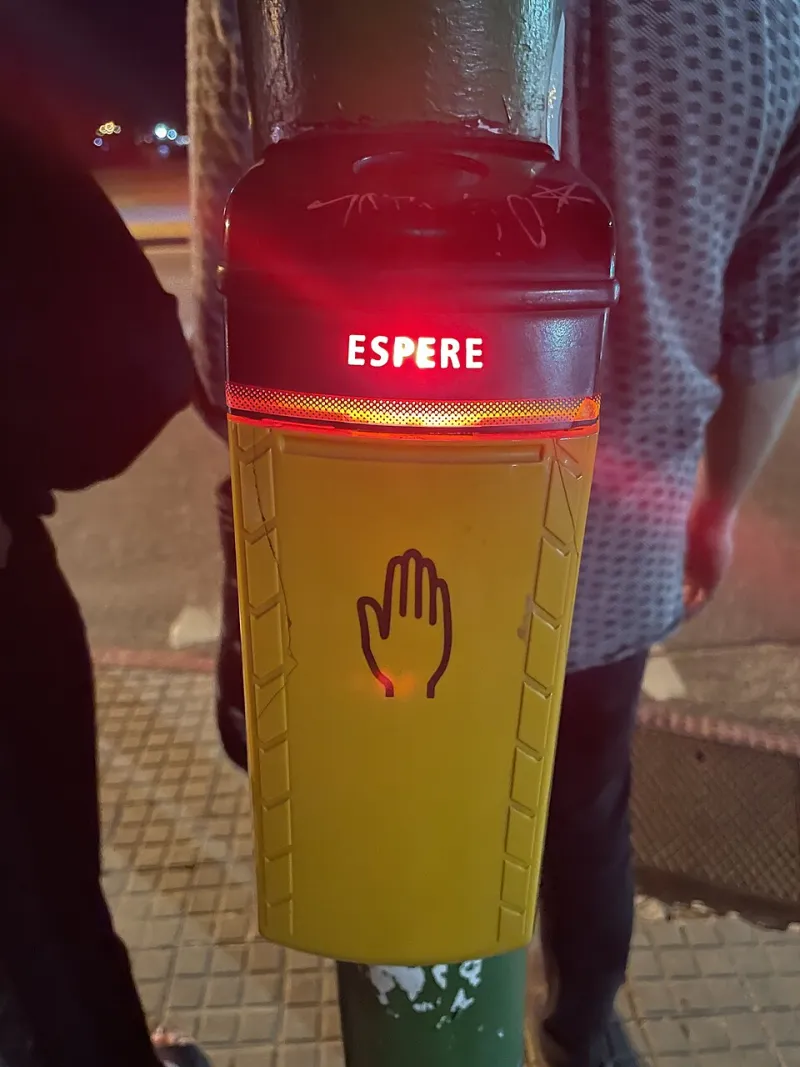
Photo: Alex Chan, CC BY 2.0, via Wikimedia Commons
Leeds city centre is crossed by a dense network of signal-controlled pedestrian crossings. For many people they are routine. For a deafblind pedestrian they are a sequence of small, precise tests: can the kerb be found, does the tactile paving lead to the button, does the rotating cone turn when the green man appears, is the audible signal loud enough to be heard above traffic, and is there enough time to cross without hurry? As of November 2026, these questions remain central to whether the city centre is genuinely open to deafblind residents and visitors.
This article is not a general essay on street design. It is a local audit guide: what to check at a controlled crossing, what Deafblind Hub readers have reported, and how to report a fault so that it reaches the right part of Leeds City Council.
The Components of an Accessible Controlled Crossing
A signal-controlled crossing is not one facility but several working together. If one part fails, the crossing can become unusable even when the visual green man still appears.
- Tactile paving at the kerb should be present, correctly laid and undamaged. The pattern should mark the crossing point rather than a random patch of footway. The same expectation applies on the opposite side and on any refuge island.
- Rotating cones under the push-button unit should turn only when the pedestrian phase is active. A cone that is stiff, slow or silent is a fault, not a quirk.
- Audible signals should be distinguishable from surrounding noise. Volume and tone matter, but so does consistency: a signal that works on one arm of a crossing and not another creates uncertainty.
- Push-buttons should be reachable from a seated position and from both sides of a wide footway. The tactile arrow or button shape should be identifiable by touch.
- Crossing timings should allow a person with reduced mobility, a guide dog or a long cane to cross at a steady pace. The green man is not a universal indicator; for deafblind people, the tactile and audible cues carry the information.
- Approaches should be free of pavement clutter: bins, A-boards, café seating, parked vehicles, e-scooters and temporary works. A clear crossing is not only the crossing itself; it is the route to it.
Auditing the Route, Not Just the Crossing
In Leeds, the busiest crossings around City Square, The Headrow, Briggate, Park Row, Cookridge Street, Vicar Lane, Boar Lane and Neville Street each have their own pressures. A crossing that performs well in a quiet moment can fail at 5pm, when engine noise masks an audible signal and pavement clutter narrows the approach.
An audit should therefore be done at different times of day and in both directions. The question is not simply whether the equipment is present, but whether a deafblind person can find it, operate it, confirm the phase and cross without being forced into the carriageway.
What Residents Report
In conversations with Leeds Deafblind Hub, one guide dog owner described a city centre crossing where the audible signal was drowned out by engine noise at peak times. Another reader who uses a long cane said the rotating cone on their regular route had become stiff, requiring more than one press and a wait to confirm that it was turning. A third described temporary works that diverted pedestrians into the carriageway without a tactile route around the obstruction.
These are not unusual complaints. They illustrate the difference between a crossing that exists and a crossing that works. They also show why fault reporting needs to be specific: ‘the crossing is not working’ is harder to act on than ‘the rotating cone at the eastern kerb of this crossing did not turn when the pedestrian phase was active at 8.30am’.
Timings, Confidence and the Hold Question
A crossing phase that is adequate for a brisk walker may not be adequate for someone who needs to locate the kerb, listen for traffic and move off with a guide dog. Some signals have extended-time buttons, but not all are well marked or reachable. Where a crossing has a refuge island, tactile paving should mark both kerbs and the island itself.
The hold question matters too. If the button is pressed, does the signal hold long enough for the person to cross? A deafblind pedestrian may not see the green man; they rely on the cone and the audible signal. If the audible signal is absent, the crossing is not accessible even if the visual signal works.
How to Report a Fault to Leeds City Council
Leeds City Council is the highway authority for most city centre roads. Faults should be reported through the council’s online ‘report a problem’ route for highways and street furniture. If the fault is an immediate danger, residents should call the council rather than wait for an online form to be processed.
A useful report includes:
- the exact location: street name, nearest junction and which side of the road;
- the type of crossing and the position of the button or cone;
- the fault: missing or lifted tactile paving, a cone that does not rotate, an audible signal that is silent or too quiet, a timing issue, or an obstruction;
- the date and time, plus traffic and weather conditions;
- a photograph if it is safe to take one.
Residents should ask for a reference number and keep a record of the report. If there is no response, the local councillor can be asked to follow up. For an immediate risk to life, call 999.
A Ten-Minute Audit Checklist
A simple audit can be carried out with a sighted guide, a support worker or a Deafblind Hub volunteer working alongside the deafblind person, not on their behalf.
- Approach the crossing and check that the tactile paving is present, level and unobstructed.
- Locate the push-button and confirm that it can be reached comfortably.
- Press the button and check whether the rotating cone turns during the pedestrian phase.
- Listen for the audible signal and note whether it can be heard above traffic.
- Time the crossing at a steady pace and note whether it feels sufficient.
- Check the opposite kerb and any refuge island for tactile paving and obstructions.
- Repeat in the other direction and at a different time of day if possible.
Crossings are small pieces of infrastructure with large consequences. Regular audits, clear reporting and a responsive highways service can make Leeds city centre more predictable for deafblind pedestrians. Leeds Deafblind Hub will continue to collate local reports so that the gap between a signal and a safe passage is closed.