Room to Join In: A Venue Guide for Deafblind-Friendly Meetups in Leeds
The intention behind a Leeds coffee morning is almost always good. The room, unfortunately, often is not. A backlit window, a bare floor, a buffet queue and an invitation sent as a photograph of a poster will quietly exclude the very people the event was arranged for.
None of that is difficult to fix. What follows is a working guide for organisers, cafés, community halls and charities across the city, drawn from the kind of practical questions Leeds Deafblind Hub asks before booking anything.
1. Start with the invitation, not the room
The first accessibility decision is the message that goes out.
Send joining instructions as plain text in the body of an email, not as an image or a scanned flyer. State where the event is, the time, the nearest bus stop and the step-free entrance. Say which communication support will be present and what can be arranged if asked. Give a named contact, an email address and a phone number that accepts Relay UK calls. Publish a deadline for support requests, because BSL and deafblind interpreters are booked weeks in advance, not days.
If you use social media to promote the event, add a text description of any image and repeat the essential details in the post itself.
2. Lighting: the single biggest factor
Deafblind people read faces, hands and lips, and all of that depends on light.
Avoid seating anyone in front of a bright window. Backlighting turns a speaker into a silhouette. Aim for even, diffuse light across the room, with no harsh pools from downlights and no glare bouncing off a white wall. Around 200 to 300 lux is a sensible general level, adjustable if possible. Bring a couple of floor lamps if the venue is dim; it is a small expense that transforms a room.
3. Acoustics: soft surfaces, working loops
Hard floors, high ceilings and glass walls turn speech into noise, and noise is exhausting for anyone lipreading or using residual hearing.
Look for carpet, curtains and soft furnishings. Ask whether the venue has a hearing loop, then test it on the day and put up a sign that it is working. A portable loop is a reasonable backup. Above all, make sure the room has a door that closes, so the group is not competing with a coffee machine and a queue.
4. Layout and furniture
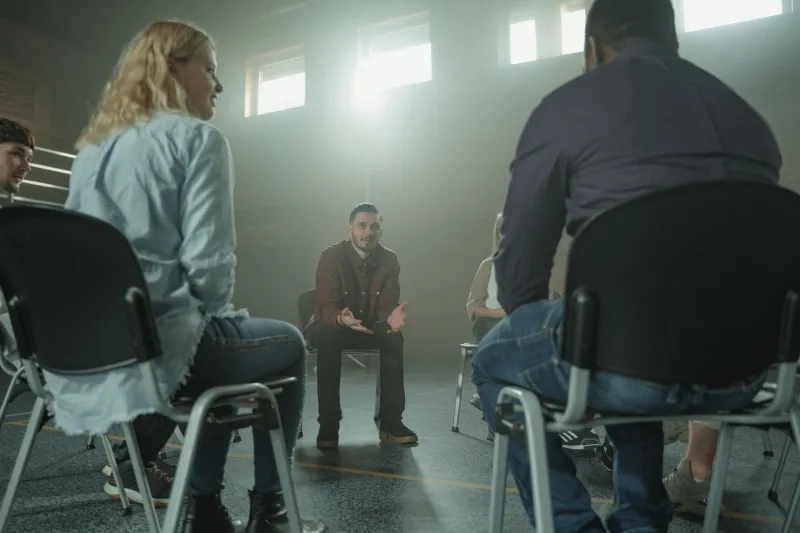
- Arrange chairs in a circle or horseshoe so everyone can see everyone else.
- Keep groups small. Above roughly twelve people, cross-conversation becomes unmanageable for a deafblind participant.
- Leave clear, wide paths for guide dogs, wheelchairs and canes, and do not move furniture once people have arrived.
- Choose chairs with arms; they help with orientation and with sitting down safely.
- Reserve seats near the interpreter and near the best light.
5. Wayfinding and tactile cues
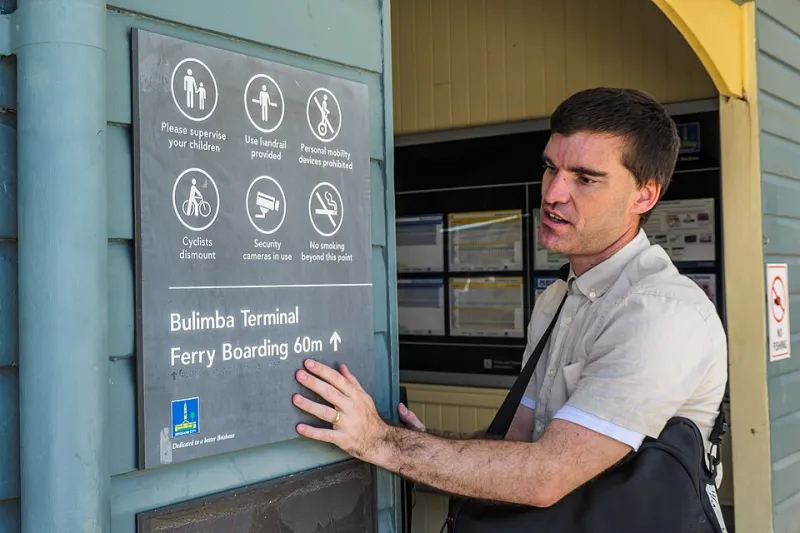
Signage should be large print with strong contrast, mounted at a consistent height, and paired with braille where the venue can manage it. Better still, put a person at the door whose job is simply to greet people by name and describe the room: where the tables are, where the exit is, where the quiet space is.
Tactile markers on tables and a consistent, uncluttered layout do more for confidence than any amount of signage.
6. Communication support, booked properly
For anything longer than about ninety minutes, book two BSL interpreters so they can rotate. For deafblind attendees, ask what they use: deafblind manual, hands-on signing, clear speech, a guide communicator or a deafblind interpreter. Lipspeakers and notetakers are separate bookings, not substitutes.
Brief your support workers in advance with an agenda, names, and any jargon likely to come up. On the day, position interpreters where their faces are lit and visible to the people relying on them.
7. A quiet space that is actually quiet
A corridor is not a quiet space. Book a separate room with a door, soft lighting and seating, and keep it available throughout. Staff it with someone who can communicate with a deafblind person and who knows where the facilities are.
8. Refreshments without a scrum
Buffets and queues are hard to navigate with limited vision and impossible to manage while holding a cane. Table service, or a member of staff taking orders, removes the problem entirely. Check the payment options in advance: a card-only café is a barrier for anyone who budgets in cash. Describe food rather than relying on small handwritten labels.
9. Transport and arrival
Choose venues within easy reach of a bus stop on a route served by West Yorkshire Combined Authority services, or a short, level walk from Leeds railway station or Leeds Bus Station. Anything in the city centre, Chapel Allerton, Headingley or Kirkstall can work if you publish the specifics: which stop, which direction of travel, which door, and whether the pavement slopes.
Offer to meet people at the entrance. Ten minutes of staff time removes an entire category of anxiety.
10. Afterwards
Follow up in each person's preferred format. Ask what worked and what did not, and write it down so the next event starts further ahead than the last.
The venue enquiry checklist
Before you book, ask the venue:
- Is there step-free access from the pavement, and where is the drop-off point?
- What are the light levels, and can the room be arranged in a circle?
- Is there a working hearing loop, and will you test it with us?
- Can we have a separate quiet room for the duration?
- Is the café able to offer table service and accept cash?
- Can we put up large print signage without damaging the walls?
Get those answers in writing and you have the basis of an event that people can actually attend. The difference between a well-meaning coffee morning and a genuinely accessible one is rarely money. It is a list of small, deliberate choices made before anyone arrives.